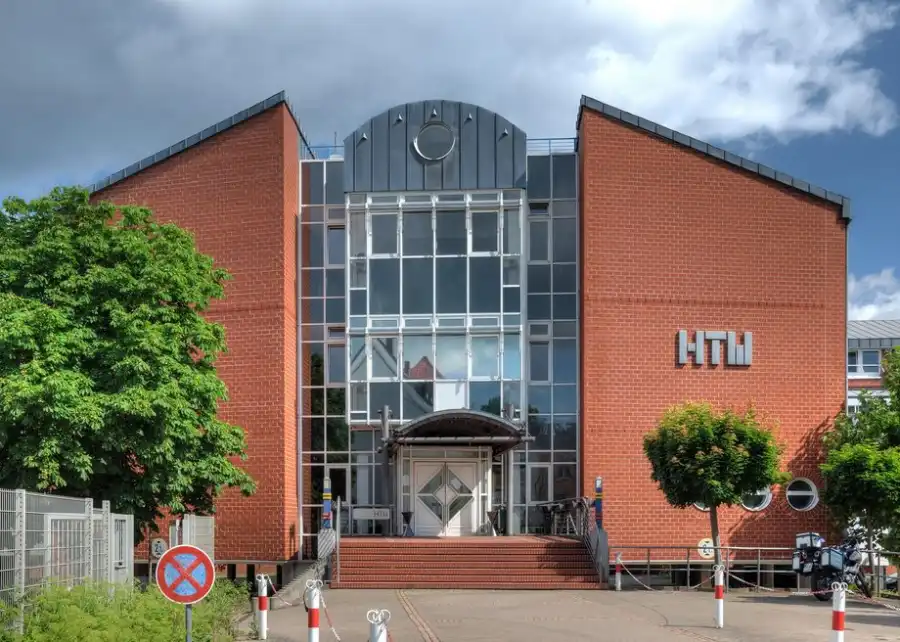
HTW Berlin (Hochschule für Technik und Wirtschaft Berlin)
HTW Berlin is one of Germany’s larger Universities of Applied Sciences (Fachhochschulen), based in Berlin. It offers industry-linked programmes in engineering, business, and IT, and is part of Germany’s HAW system, which is distinct from, and equally recognised alongside, the country’s research-focused Technische Universitäten.
Institution size
Large, one of Germany’s biggest HAWs
Min. CGPA floor
Modified Bavarian Formula
Tuition / yr
Near-free at public German universities
Type
Public University of Applied Sciences (HAW/Fachhochschule)
Key Facts
| Category | Detail |
|---|---|
| Location | Berlin, Germany |
| Type | Public University of Applied Sciences (HAW/Fachhochschule) |
| Institution size | Large, one of Germany’s biggest HAWs |
| Rankings | Universities of Applied Sciences (HAWs) such as HTW Berlin are generally not covered by global research-focused rankings like QS or THE, which weight research output heavily; HTW Berlin is well regarded nationally for applied, industry-linked education. |
| Notable feature | Practice-oriented curriculum with strong industry ties |
| Official website | htw-berlin.de |
Admission Requirements for Low CGPA and Backlog Applicants
- German universities generally evaluate a converted final grade rather than auditing individual backlogs
- Common conversion method: Modified Bavarian Formula, converting international CGPA into the German 1.0–4.0 scale using the final result
- A CGPA of approximately 7.0 out of 10 typically converts to roughly 2.8 on the German scale
- Most HAWs, including HTW Berlin, require a converted grade of 2.5 or better
- Backlogs cleared in later semesters generally carry limited weight, since the conversion formula is based on the final completed result
Tuition and Fees
| Item | Approximate Amount |
|---|---|
| Tuition | Near-free at public German universities |
| Semester contribution fee | A few hundred euros, often including a public transport pass |
| Blocked account requirement (visa) | Approximately EUR 11,904 per year |
| Living costs (Berlin) | EUR 850–1,200 per month |
Confirm current rates directly with international admissions office.
Programmes Offered
- Business Administration and International Management
- Computer Science and Engineering
- Industrial Engineering
- Mechanical and Electrical Engineering
Degree Levels Offered
- Diploma / Certificate: Offered
- Undergraduate (Bachelor’s): Offered
- Postgraduate (Master’s / MSc / MA): Offered
- Doctorate (PhD): Not offered at this institution
- Post-Doctoral Fellowship: Not offered at this institution
- Short Courses: Offered
Availability of Short Courses and Post-Doctoral Fellowship positions can vary by department and is not always centrally advertised; confirm current openings directly with the relevant faculty.
Scholarships and Funding
- DAAD scholarships available for eligible applicants on a competitive, national basis across German universities
- Near-free public tuition itself functions as HTW Berlin’s primary structural cost advantage, rather than a specific institutional scholarship
- Some departments offer limited research assistant positions for master’s students; confirm availability directly with the relevant faculty
Application Process
- Obtain a CGPA conversion via the Bavarian Formula or a formal uni-assist evaluation
- Confirm the specific programme’s exact grade requirement, which may vary by department
- Prepare transcripts, degree certificate, motivation letter, and language proficiency proof (English or German, depending on the programme)
- Apply through uni-assist or directly via HTW Berlin’s application portal
- Open a blocked account and gather financial documentation
- Apply for a German student visa at the nearest German embassy or consulate upon admission
Admission Outlook
Germany’s conversion-based admission model, applied at HTW Berlin, evaluates an applicant’s final academic result rather than a semester-by-semester transcript history. This structurally favours applicants with cleared backlogs and a reasonable final CGPA over systems that screen line-by-line for academic gaps.
Campus Life
Berlin carries higher living costs than smaller German cities but offers access to one of Europe’s largest technology and startup job markets. Programme language of instruction varies between English and German at HTW Berlin; applicants should confirm this directly, since it affects both admission requirements and daily life outside the classroom.
International students generally have access to a dedicated international student office, orientation programming, and student clubs and societies. Housing options typically include on-campus or university-affiliated accommodation alongside private rental options; applicants should apply for housing as early as possible after accepting an offer, since availability varies by intake and city.
Other Essential Information
| Category | Detail |
|---|---|
| Typical intakes | The Winter semester (starting October) is the primary intake with the widest programme availability; the Summer semester (starting April) offers more limited choice. |
| English language requirement | IELTS overall band 6.0-6.5 is typical for English-taught programmes; German-taught programmes require B2-C1 level German proficiency. |
| Student visa type | National (Type D) Visa, followed by a residence permit for studies |
| Post-study work options | Graduates may apply for an 18-month residence permit to seek qualified employment after completing their degree. |
Official Resources
- University homepage: htw-berlin.de
Compare Auburn against other accessible universities on our Find a Course page, or contact us for help evaluating your eligibility.